


For Halloween, we’re rerunning the two-part post mortem for what is in many respects ihobo’s most beloved game. Some minor edits have been made to the grammar.
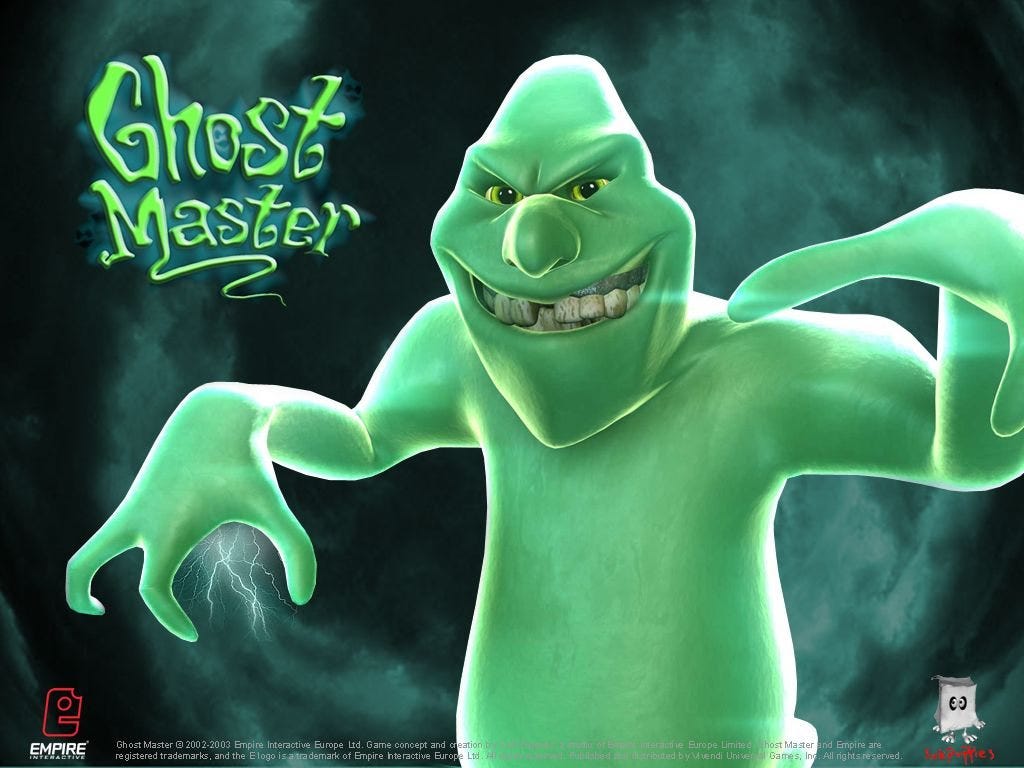
Two years after the release of Ghost Master (PC) seems a little late for a post mortem, but there is much to be learned from examining just what went wrong with this game. Of particular note is that what went wrong wasn't, for once, the result of ‘bad design’. In fact, the design was perfectly serviceable for a first title in a franchise, although this doesn’t mean there wasn’t room for improvement (there always is room for improvement!) What went wrong, broadly speaking was a total lack of marketing.
I was the game designer on this project – although the project director, Gregg Barnett, made the content decisions and worked closely with me on the game design. A good way to understand the relationship between Gregg and myself on this project: Gregg made all the decisions; I gave him the options and generated all the design documentation. The game would be utterly different without our creative partnership.
Let’s begin with why I don't consider the game design to be ‘bad’. Well, subjective issues aside, the 81% Metacritic review score is a fairly convincing vindication for a game developed on about a quarter of the budget of most other critically-acclaimed games. Since it didn't have the budget to wow players with its production values, it came down to the quality of the game design and the skills of the programmers and artists. This latter point should not be overlooked: the Sick Puppies team was built from the ground up by Gregg and was exceptional. A game designer can only be as good as the team behind them, and this team was first rate.
Note that one of the reviews listed on Metacritic is PC Gamer (US) magazine, which gives it a 90% score. PC Gamer is allegedly the most influential video game magazine in the world; certainly it is the game magazine with the largest global circulation. Industry wisdom claims that getting a 90% in PC Gamer all but guarantees a top ten best selling game.
That’s not what happened to Ghost Master. In fact, it vanished practically without a trace.
What went wrong?
I’m going to look at two particular elements in the game's commercial failure – audience model errors (which were my responsibility) and marketing failure (which was not). I’m also going to look at the extent to which genre confusion hurt the game, although this is at best a secondary issue.
Audience Model Errors
When I designed Ghost Master, our audience model wasn't very sophisticated. It was the Hardcore-Casual split, the most basic model at use in the industry. Still, it is better than nothing, and I can hardly be blamed for not having a better model since until we researched ours, there wasn’t a better model (Nicole Lazarro’s Four Keys didn’t exist yet either).
I badly misread the Hardcore on a number of points, chief of which were:
Hidden Fiero: Believing that innovation and well designed gameplay would meet the play needs of the Hardcore. It did for some players – but not for those for whom fiero [the emotion of triumph over adversity] was a key play need. There is fiero to be found, but only in going for the “Triple Pumpkins” (effectively gold medals). Since most fiero-seeking players (Conquerors in DGD1) found little or no fiero in their initial play through, they never tried for the Triple Pumpkins and hence never found the fiero. Also, the esoteric name for the medals (Gregg delighted in maintaining the consistency of a game’s identity) meant they weren't interpreted as medals. We would, in fact, have done better to call them Medals – as then at least some of the Conqueror players would have felt more compelled to tackle the more difficult Triple Pumpkin challenges!
No Micromanagement: The gameplay was designed to allow the player to genuinely be in charge of a team, reacting to dynamic situations by making leadership decisions. Strong ghosts in your team could compensate for the lesser skills of an inexperienced player, whilst adept players could enjoy the satisfaction of commanding a well-oiled team. The key to this was a simple but effective AI subsystem for the ghosts themselves, who acted as quasi-autonomous agents. (This is one of the few games to have such complex agents, in fact). Because of the highly dynamic environment – you can never reproduce exactly the same results even with the same haunters – the game supports Tactical and Strategic play but not Logistical play. Say goodbye to the players fitting the Conqueror archetype once again.
One other problem: the game was too short. This was not strictly our fault, since most of the game budget was required to get everything up and running, and the environments required a lot of care and attention to produce. Furthermore the method used to develop the game locations did not support the option for a level editor without a great deal of additional time and expense. This particular problem would have been fixed had we got a sequel – we all agreed it would have been a priority for Ghost Master 2, a game that now can never happen.
The trouble with games being too short is that they don’t stay in circulation. Even if a large proportion of Hardcore players love a game, if they complete it in a week and there’s nothing to go back for, they go on and start playing something new. That only gives you a week for them to recommend it to someone else in real terms. It's what we have termed the ‘play window’ of the game and for Ghost Master, it was cripplingly short. Part of the secret of the success of the recent GTA games is a huge play window – it allowed word of mouth to build. I’m not saying we could have been as big as a GTA game on our tiny budget, but the point still stands.
So we don't have the support of the Conqueror players, and the game is too short for word of mouth to build up momentum... Both of these elements hurt us, because with the support of players fitting the Conqueror archetype (who are in general vocal supporters of the games they love) and a long enough play window, we might have been able to survive the game’s other problem.
Marketing Failure
How can I competently tell that this was a case of marketing failure? Well, there are two key pieces of evidence. Firstly, the news that Gregg reported to me from his contacts in the US which described Vivendi’s promotion of the game at release as “the worst campaign Vivendi has ever mounted”. If you saw any promotional materials for the game anywhere in the US – any advertising, point-of-sale fixtures, posters or anything else at all, please let me know – you might be the only witness to this unbelievably lacklustre affair.
The second piece of evidence is my first hand observation of what happened at launch. I was able to find the game on the shelves in the States, but I had to look, it wasn’t stocked in every store (only one out of four chains in the region I was visiting had it), and in all cases the staff in the video games shops had either not heard of the game, or was only aware of it sufficiently to know it was on the PC shelf. This generally happens only when the publisher drops the ball on its marketing campaign (or when there is no marketing campaign).
I may never know exactly why this happened but there are two schools of thought. The first school says: Empire (the publisher who owned Sick Puppies) basically pissed off Vivendi, and so Vivendi snubbed the game. The second school says: whoever made the decisions inside Vivendi assessed the game as not very significant, and assigned a marketing budget accordingly; when the PC Gamer review came in, nobody thought to shift gears and initiate a second round of marketing. Perhaps they figured it was too late at that point.
Combined with the audience model errors, the marketing failure meant the game was never to have any commercial success, despite a very positive critical response.
“But It’s a Strategy Game”
Although it's a small point, part of the problem with the game was that it didn’t go down well in the UK, and so the assumption was that there was a problem with the game. Well, there was a problem with the UK release: it was rushed, and we hadn't ironed out all the bugs until the US release, but of course, this wouldn’t have mattered if we’d had the Hardcore support. At the time (and possibly still now) the specialist press in the UK strongly resembles the Conqueror archetype, and agon (competition) and fiero (triumph over adversity) appear to dominate the play needs of most UK specialist press reviewers. As already mentioned, it was a bad fit to the audience – but it shouldn't have mattered, because Gregg and I had always known that the German and US audiences were the key to the game's success. (I have no idea what went wrong in Germany, incidentally – probably similar problems to the ones already mentioned).
Chatter in the forums behind the scenes of the specialist press showed up all manner of extremely negative response, characterised by one particularly vitriolic individual who declared the game “the easiest strategy game ever” – meaning this to be an insult. (Presumably the point here was that the player in question couldn’t manage to get the game to provide any fiero for them). Consider also this extract from the PC Format review:
The puzzle elements are more like extremely simple exercises that you have to complete, rather than challenging problems that need solving, and the same is sadly true for the strategy.
This person sounds like they are closer to the Manager archetype in DGD1 (i.e. interested in puzzles and strategy) but clearly the failing point here a mismatch between their skills and the level of challenge the game provides. (Fiero is not just for players preferring Conqueror-style play, of course). Now it must be said, some of the puzzles in the game are in fact seriously challenging, and only an extremely expert adventure game player could possibly dismiss all the puzzles in the game as ‘extremely simple exercises’ – but this is beside the point, as I didn’t actually intend for the puzzles to be hard. They were supposed to be relatively simple, because they weren’t supposed to represent the core gameplay, which is about how you use your team. Again, this player almost certainly never tried for the Triple Pumpkins, which are really quite challenging strategically, especially Full Mortal Jacket and, to some extent, Haunting 101.
As an aside, let me just say that I never wanted the puzzles – it was something Gregg made me put in. According to him, the publisher asked for puzzles because they couldn’t understand what the game was about otherwise. This may not be the whole truth, however. Gregg has a love of puzzles, and a gift for making them which far outstrips my own talents in that particular area. I wanted to just focus on the gameplay inherent in the haunting itself, although in retrospect having the puzzles wasn’t significantly problematic.
From responses like those above, it seems there was a definite intent to interpret the game as a strategy game. I’m not an expert on the genre, but I would predict that many popular strategy games are sources of fiero because the player fails certain battles over and over again (thus experiencing fiero when they beat it). Ghost Master isn't like that – the levels are relatively easy to beat, they are just hard to beat completely.
Seeing the game as a strategy game therefore hurt us in some indefinable way, although as mentioned above, the biggest problem in this genre mismatch was probably that it hurt how the game was marketed. On the one hand you have a box which suggests “this is like The Sims”, and on the other you have some reviews or word of mouth which say “this isn’t a very good a strategy game”. We strayed too far from genre expectations, and this hurt us simply because there wasn’t a ready-made cluster of game evangelists waiting to support the game.
Instead, there was a ready-made cluster of strategy fans who, apparently, didn’t get to grips with the idea of a strategy game in which you lead your units (your ghosts), rather than controlling their every move. This probably reflects the fact that most strategy games are in fact tactical games – very few real time games require Strategic skills to play well; most require quick thinking responses (Tactical skills) or methodical planning and optimisation (Logistical skills).
The lack of direct control also probably hurt us: we should probably have given the player the capacity to directly control the ghosts if they wanted to. We didn’t because it would have destroyed the original gameplay we’d created (turning novel new gameplay into a modified FPS). For anyone for whom watching the ghosts act out your plans was insufficient, having direct control would have been some compensation, though. It was planned for the sequel (but would have been designed such that it would not have been in any way necessary).
Lessons Learned
I learned a lot from Ghost Master, much of it about the importance of marketing a game, the treacherous landscape of the games market, and the problems of trying to promote a game without a clear genre to inform people how to interpret it. Collectively, people do not accept new approaches to play with an open mind. Everything is assumed to be related to other things, things that have already been seen. This isn’t true for every individual, of course, but when you average over a large enough group of people…
If we had got a sequel, I believe we could have ironed out a lot of the problems the game had – but sadly the games industry is a vicious marketplace which throws away a lot of the value that it creates. When EA bought Bullfrog, they threw away all its IP because there was nothing in their portfolio with a big enough following to operate at EA's scale. But a smaller publisher could have made a profit on franchises such as Dungeon Keeper, Populous and Theme Whatever – not that EA would sell-on the IP, because that would be helping their competitors. The fact that their competitors are so small as to make such a sale practically foreign aid from a superpower to a banana republic is somewhat beside the point. So these franchises are lost forever, just as the Ghost Master franchise that never was is now lost forever.
It’s not really a huge tragedy, when all is said and done, after all, it’s only a game. Mind you, it does demonstrate that the constant talk of desire for ‘innovation’ in games is either a minority desire, or is only a half truth. I suspect what people want are new variations on established themes – why else would God of War, the most advanced and expensive scrolling beat-em-up ever made, be oft praised as ‘innovative’ rather than being considered an especially slick and impressive take on a genre which is almost twenty years old? Why else would Halo often be considered an innovative FPS, rather than a skilfully crafted pinnacle of an already codified form?
I feel truly innovative games should transcend, expand or defy genre, but this in turn may make them harder to sell to the audience at large. It certainly didn’t help Ghost Master that it wasn't designed to belong to a particular genre, but that doesn’t mean that it should have done – it just means one should be careful straying too far from the genre norms unless you either have marketing on your side, or you don’t need to capture too large an audience.
One final note: although I’m certain the delusion was in our heads at the time that we would capture some of the audience of The Sims with Ghost Master, it is now abundantly apparent that this could never have happened (from the perspective of our DGD model, at least; the game doesn't really support the social-style of Participant play). Still, in an online appearance, Wil Wright said that Ghost Master was the best ‘Sims-like’ game he'd seen so far, which is a nice compliment in anyone’s book, although perhaps not the most fitting epitaph to this unusual but commercially doomed game.
Note: We didn't work on the console versions, and I have never played them. This is solely about the original PC version. Thanks for your patience with this excessively long and rambling post which is probably of limited interest to most people.