


The concluding part of the breakdown of ihobo’s most beloved game, reposted for this year’s Halloween. It has been lightly edited for grammar.
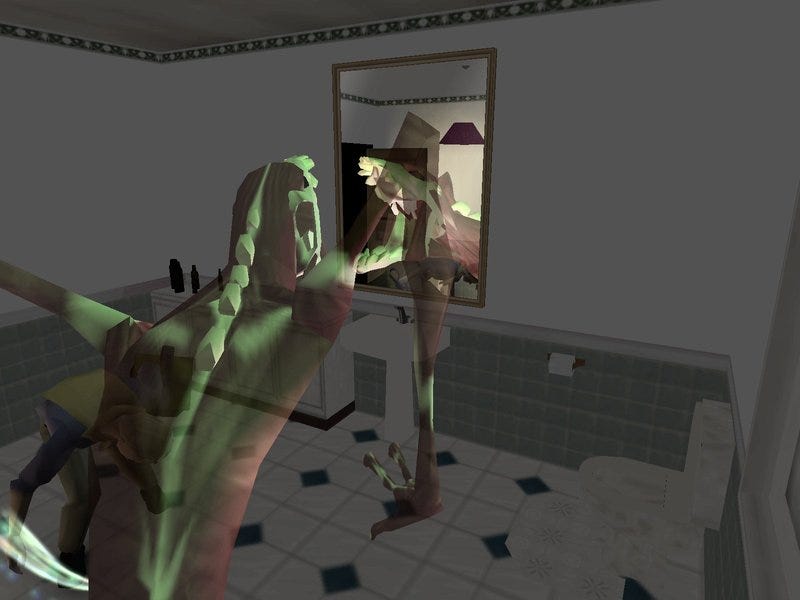
In the last part, we looked at what went wrong with the PC version of Ghost Master, an innovative haunting game developed by the now-disbanded studio Sick Puppies and designed by my team at International Hobo. In this final part, we look at what went right in the game design, and how the elements of the design came together.
Originally, I hadn’t intended for this to be a two-part piece, but popular demand (read: one comment) convinced me that the post-mortem would be more complete, and more balanced, if I also took the time to comment on what worked in the game, and the positive side of the game design process for this project.
The Concept
Before the Sick Puppies studio even existed, Gregg came to me with a concept for a haunting game and asked me to come up with an initial design. Gregg and I had previously worked together at Perfect Entertainment on the acclaimed Discworld adventure games, and we had developed a good working relationship.
Gregg’s initial concept had a strong vision, which is always an asset in a game. He wanted to build a haunting simulator inspired by reality television, placing people into a confined environment and manipulating events around them. Since it was a virtual environment, haunting was a natural fit and created opportunities for striking visual effects.
The centre of the gameplay was clear right from the beginning: scaring people is fun.
The core concepts were:
The player controls a team of ghosts (Haunters) which they position to scare people (Mortals).
Mortals have different degrees of Belief. High-Belief mortals are easy to scare, while sceptics require convincing of the supernatural.
Mortals possess Willpower, determining how much Terror is required before they Flee.
Terror generates resources. Fear Factor is converted into Plasm, which powers Haunter abilities.
In essence:
Scare Mortals to gain Plasm, then use Plasm to power Haunters that scare Mortals.
Haunters & Fetters
One key design goal was to minimise micromanagement. The player’s primary decisions would be:
Where to place ghosts.
How much power to allocate to them.
Different Haunter families could only be bound to certain objects or locations called Fetters.
Examples:
Gremlins bind to electrical items and manipulate machinery.
Banshees bind to thoroughfares and specialise in noise and weather effects.
To keep the system intuitive, eligible Fetters highlight automatically. New players can experiment immediately, while experienced players naturally learn deeper strategies through use.
The placement system became central to gameplay. Success depends on predicting where Mortals will travel and positioning ghosts accordingly rather than constantly reacting to movement.
Powers & Plasm
Haunter powers are organised into ten power bands.
Band 1 contains the weakest powers.
Band 10 contains the strongest powers.
More powerful Haunters can access higher bands.
Plasm determines which band a Haunter can currently operate within.
The player’s decision is not selecting individual abilities but choosing the power level of each ghost. The Haunter AI then chooses which specific power to use.
This approach provided:
Simple player choices.
Large strategic variety.
Distinct personalities for different Haunter families.
A novice can simply deploy ghosts and maximise power levels, while experienced players optimise power allocations and specific ghost combinations.
The Mathematics of Fear
Plasm is generated from a metric called Fear Factor, derived from the Terror and Willpower of all Mortals.
The initial design faced two major challenges:
Problem 1: No Starting Fear
At the beginning of a haunting, nobody is scared.
Solution:
Mortals begin with a small amount of Terror.
A “Ghostly Presence” rule prevents this starting fear from fading before the player acts.
Problem 2: Running Out of Plasm
Low Fear Factor values could theoretically leave players unable to activate any ghosts at all.
Solution:
A revised formula ensured a minimum usable Plasm level regardless of Fear Factor.
Players always retain access to at least basic powers.
The resulting structure naturally created three phases:
Exploration – assess the level and prepare.
First Strike – secure early fleeing mortals and stabilise Plasm.
Elimination – use accumulated resources to deal with tougher targets.
Annoying People & How to Dispose of Them
Mortals are defined by:
Belief
Willpower
Personal fears
Madness
Madness introduces alternative victory routes.
A Mortal can be defeated by:
Convince & Scare
Increase Belief using obvious supernatural effects, then generate Terror.
Uncover Their Fears
Discover hidden fears and exploit them using appropriate Haunter powers.
Drive Them Mad
Increase Madness until it exceeds Willpower, causing permanent insanity and effectively counting as a Flee result.
Mad mortals also frighten other mortals, creating useful chain reactions!
Team Selection
Before each mission, the player assembles a team of Haunters.
New ghosts are recruited during hauntings by solving the local problems that bind them to specific locations.
Several design challenges arose because:
Different players recruit different ghosts.
Certain missions require specific capabilities.
The solution was a recommendation system that provided suitable team suggestions while adapting to the ghosts currently owned by the player.
The recommended teams are competent by default but still leave room for player optimisation.
The Trouble with Time Travel
Replaying earlier hauntings uses an in-game Time Gate system.
Technical limitations meant not every ghost could be used in every past level. Some ghosts, such as the Dragoon, required level-specific implementation work, making unrestricted replay impractical.
Another controversial restriction limited the amount of Gold Plasm players could earn through replaying levels. In retrospect, that restriction probably reduced player freedom without offering meaningful benefits.
Ghost Toys, Ghost Games
I’m extremely pleased with the core mechanics I designed for Ghost Master. The game manages to balance being both:
A toy, allowing players to experiment and enjoy the spectacle.
A game, supporting deep strategy and optimisation.
One regret is the lack of a true sandbox mode. Feedback from parents and younger players showed many people simply enjoyed playing with the ghosts and exploring the systems. Had there been a sequel, a fully unrestricted sandbox mode would almost certainly have been included.
Ghost Master has its flaws, but it achieved its central design goals and offered something genuinely different in an industry often reluctant to move far from established formulas.
To everyone who played and enjoyed Ghost Master, you have my thanks. You made the whole process worthwhile!