


Almost every videogame has elements of mimicry. When we sit down to play a game, we know that what is happening is not real; we suspend our disbelief in order to allow the game to sweep us away into its situation and world. The game is a tool for imagination – whether we’re imagining that we’re a heroic warrior‑priestess, a gun‑toting action hero, a hard‑driven career woman, or a fluffy animal. We do not usually consider this aspect of the game to be at the centre of the play... But are we being blinded by an excessive focus on challenge? Is mimicry more of a draw than we realise?
Mimicry is one of four cross-cultural patterns of play identified by the eclectic intellectual Roger Caillois in 1958. He described mimicry as follows:
All play presupposes the temporary acceptance, if not of an illusion (indeed this last word means nothing less than beginning a game: in-lusio), then at least of a closed conventional, and, in certain respects, imaginary universe. Play can consist not only of deploying actions or submitting to one’s fate in an imaginary milieu, but of becoming an illusory character oneself, and of so behaving. One is thus confronted with a diverse series of manifestations, the common element of which is that the subject makes believe or makes others believe that he is someone other than himself. He forgets, disguises, or temporarily sheds his personality in order to feign another. I prefer to designate these phenomena by the term mimicry...
The pleasure lies in being or passing for another. But in games the basic intention is not that of deceiving the spectators. The child who is playing train may well refuse to kiss his father while saying to him that one does not embrace locomotives, but he is not trying to persuade his father that he is a real locomotive...
Mimicry is incessant invention. The rule of the game is unique: it consists in the actor’s fascinating the spectator, while avoiding an error that might lead the spectator to break the spell. The spectator must lend himself to the illusion without first challenging the decor, mask, or artifice which for a given time he is asked to believe in as more real than reality itself.
Caillois was writing at a time before videogames, and his focus was therefore on conventional play activities, but mimicry is especially pertinent to digital entertainment. Where Caillois talks of the actor and the spectator, in a videogame these two roles can be the same person: the player is an actor in the sense that they control their avatar, but they are also a spectator, since they are enjoying watching their avatar execute their chosen actions.
The vast majority of contemporary videogames have a huge component of mimicry. Despite being designed and structured in an immensely challenge-oriented way, mimicry added enormously to the appeal of a game like Prince of Persia: The Sands of Time, it is probably the chief reason that World of Warcraft is now outpacing EverQuest in terms of subscribers, and it is perhaps the principal reason for the astronomical success of the recent Grand Theft Auto games.
The power of mimicry can be most clearly discerned in the those games for which this is the primary aspect of play. SimCity enjoyed impressive success for its day by offering the mimicry of building a working city, although it was limited by its focus: while creating a city was entertaining, it didn’t engage a great many players for an especially long time, in part because of its inherent complexity and emotional distance. Conversely, in creating The Sims (a huge influence on my own project, Ghost Master), Maxis offered a game of mimicry with a much wider appeal – and crucially, a game with the tremendous potential to appeal to women.
It is not that mimicry appeals more to women than men, rather, it is that the types of mimicry that we are culturally indoctrinated into differ significantly by gender. Boys stereotypically to play with toy cars and weapons – and games incorporating mimicry of vehicles and weapons tend to have an agonistic (competitive) bias. Girls stereotypically play with figures (dollplay) and domestic situations (’playing house’). These play activities had never been provided as the focus of play prior to The Sims, largely because no-one had considered women a worthwhile target audience – thanks in part to enormous gender biases in games industry employment [and that never went away...]. Ten million unit sales and many satisfied customers later and (astonishingly) the industry still doesn’t recognise the significance of mimicry for hitting a wide audience!
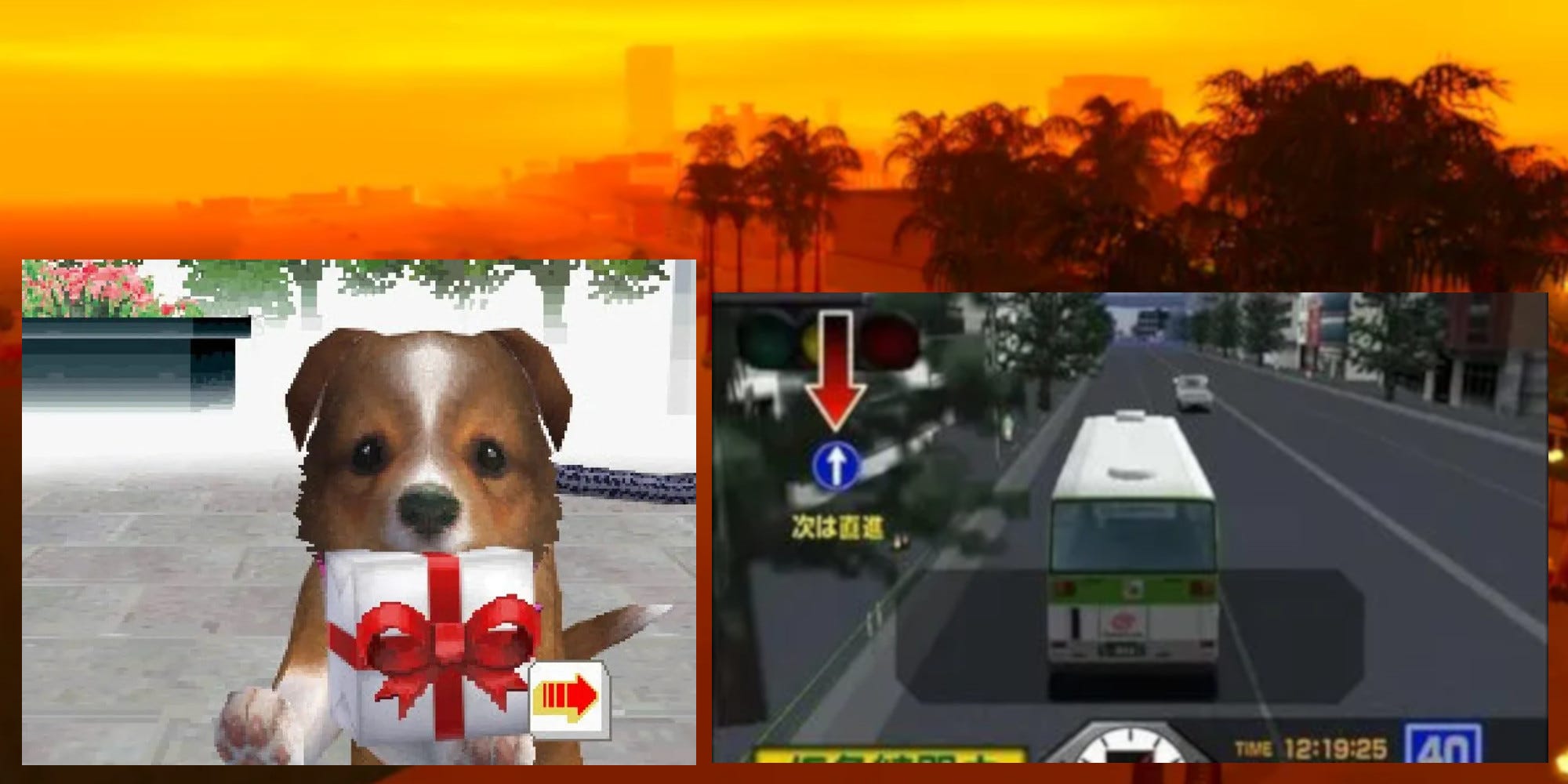
Nintendo, more than any other platform‑license holder, seems to recognise the value of this kind of play. Whereas Sony and Microsoft remain focused on challenge as the key driver for play, Nintendo have released games such as Animal Crossing, Doshin the Giant, and Nintendogs, all of which root their play primarily in mimicry. Nintendogs in particular is a game of pure mimicry – the joy of the game is pretending to be interacting with a real puppy. Its success is timely, however: earlier sprite‑based pet simulators required more suspension of belief; Nintendogs leverages the improvements of graphics power (specifically: animation quality) to enhance mimicry.
There are many gamer hobbists who claim that graphics are irrelevant to good games. Such players are probably expressing their own bias towards ludic (formal and rule‑driven) play. It is categorically untrue of people as a whole that graphics do not matter. In fact, the converse is indicated: as a mimicry enhancer, graphics are absolutely critical to the success of games in the mass market. However, most games fritter away their graphical advantages by delivering play in a more agonistic (competitive) context – thus appealing to the players for whom the improvements in graphics are at best an added bonus. That said, the step up in graphics between each generation is becoming rather marginal (games on the Xbox 360 look only slightly better than games on the Xbox to the average person): innovative play design is likely to become progressively more important going forward.
Note that in supplying mimicry, photorealism needn’t be a prerequisite (although it seems to be the case that for the US market, photorealism might sometimes be preferred). Since mimicry is an imaginative process, the transformation into an experience of mimicry can originate in all manner of different art styles. Clearly Lego Star Wars is not realistic in its representation, but nonetheless one gets the emotional connection with the Star Wars characters portrayed quite successfully, and it’s also relevant that we know what Lego is and can enjoy that connection to its visual design.
One can see this hinted at in Caillois’ work. He considered theatre to be the ultimate formal expression of mimicry. He was writing in the 50s, so it wasn’t that motion pictures didn’t exist, but he recognised that the masks, disguises and tricks of the theatrical tradition were a more complete expression of the draw of mimicry (which uses imagination to suspend disbelief – what some might call immersion) than films which aim to minimise the suspension of disbelief. It is possible, however, that those who find imagination difficult in adulthood (and this may be the majority of people) might only be capable of enjoying mimicry when the leap of imagination is minimised through appeals to ‘realism’. Box office receipts certainly exceed theatrical receipts, although one cannot ignore the effect of marketing in this.
There are many aspects to the expression of mimicry in games, although in broad strokes they can be considered to belong to a small set of themes: games which facilitate performance, games which provide mimicry as a challenge and games which arguably more closely resemble toys (what International Hobo has called ‘toyplay games’).
Games which facilitate performance tend to be online and multiplayer. After all, one must have an audience in order to perform! Although this is conceivable in a single‑player game (imagine a child performing for a parent, for instance) the commercial advantages seem most significant when the volume of spectators becomes sufficiently large. This is readily apparent in World of Warcraft, which shrewdly included commands such as /dance which allow for anyone to enter into ad hoc performance. However, these elements of mimicry have thus far been largely incidental, and no‑one has leveraged people’s enjoyment of performative mimicry as a primary play element yet. [I think this is still true!]
An example of a game which presents mimicry as a central aspect of its design, consider the Tokyo Bus Guide games. These pose the player with a very specific challenge: become a bus conductor in the city of Tokyo. Although there is a mode in which the player steers the bus, the game comes into its own in the mode in which the player controls only the indicators, doors and announcement system. In the play of this game, the player ‘wins’ by acting as a convincing bus conductor. They must stop the bus close to the passengers at the bus stop, indicate before pulling away – and remember to play an announcement so that the passengers know where the bus is going! Strangely compelling, the game is slightly too rigid for Western tastes, although the basic play could undoubtedly be exported in other ways.
Toyplay games are exemplified by Animal Crossing. The player is invited to mess around with the game elements however they wish. They aren’t placed in a structure which dictates goals and challenges to be overcome; rather, they are placed in an imaginary world and empowered to play. There are small challenges in Animal Crossing, such as the fishing microgame and the (optional) daily hunt for buried treasure, but these are elective components in a game which has, as its central activity the decoration and expansion of the player’s house. There is also a secondary element which is interpersonal – the player lives in a town with animals who become the player’s friends (albeit at a very low level of sophistication). This is a quintessential mimicry experience, much akin to playing with a dollshouse (play also leveraged by The Sims).
In recent years, the most successful commercial games have undoubtedly been the Grand Theft Auto games, notably Vice City (at least 11 million units) and San Andreas (at least 12 million units). Part of the appeal of these games is that the player is presented with a world to explore and play within, with an impressive lack of limitations relative to other games. Steal cars, beat up or run over pedestrians, knock over a liquor store and engage in a high‑speed police chase – these are the public face of the play of this franchise. But if one examines how people actually play these games, you will also find people driving around the cities for fun, getting dressed up and going out on a date, and sitting on the beach, watching the sun set while the radio plays a nostalgic hit. These games deliver mimicry to a degree previously unrealised. However, Rockstar North achieved this only by virtue of game budgets on a scale previously unrealised.
It is an omnipresent fallacy within the games industry that it is necessary to spend ever more money in order to make profitable games. It is true that if you want to see sales figures on the scale of tens of millions you will need a big budget – either for development (GTA) or for marketing (The Sims). But many of the games which are afforded vast budgets have no potential to tap the higher sales figures. Franchises like God of War, Prince of Persia, or Splinter Cell, which have challenge at the centre of their play are going to top out around three to five million units or so. Any mimicry included in these games is stifled by a structure which is anathematic to the play needs of a wider audience: a series of challenges which must be overcome to progress. Of course, five million units is still a good sales figure, but adding more money isn’t going to grow the audiences of these games significantly, and at some point their ever-growing budget is going to result in a loss. [Of these three, only God of War successfully adapted its design in the decades afterwards.]
Structure is the great empowerer of mimicry. The secret of GTA’s success is a structure that allows the player to simply play. The challenges are there, when the player wishes to tackle them, but they are practically secondary to the world the player is invited to have fun within. (I would argue that the GTA games could be even more successful if the unlocking of new toys was separated from the challenges on the game spine, but this is debatable.) International Hobo has termed these settings ‘playground worlds’ to reflect the focus on freedom of play. We will undoubtedly see more and more such worlds emerge – if the games industry is capable of recognising where it is succeeding, which most of the time it rather curiously is not. [On this front, the industry did come through in the decades that followed!]
The detailed graphics and animations that can facilitate mimicry are expensive, but games of mimicry need not be. Animal Crossing is a great example: it uses rather dated graphics to limit its development cost. True, the audience for such a game is less than the audience for (say) GTA – but the economics of games simply require that games make more money than they cost to make. [Actually, here I was wrong: Animal Crossing now sells as many units as a GTA!] Nintendogs is another good example, enjoying popular success despite (I am assuming) relatively modest development costs.
I strongly believe there is a vast untapped market for games which present mimicry as their core play. Firstly, such games can invite the player to play in their own way and at their own pace. They need not place frustrations in the player’s path and force the player to overcome them. This appeals to victory‑motivated players (those who thrive on triumph over adversity) but these do not appear to be in the majority. The worlds of these games do not need to be as large as a GTA world to support play – instead of large but emotionally empty worlds, they can be smaller but more emotionally invested worlds that allow more player customisation, or have non‑player characters with more personality.
In his book The Blockbuster Toy, Gene Del Vechio (a veteran marketer from major toy companies) provides eight different ways a toy can appeal to a child, all of which are based around his concept that a successful toy transforms the child in a manner which is emotionally on target. One of these is related to challenge and mastery, one is related to collecting (a form of play not covered by Caillois’ model). The remaining six are all forms of mimicry, with themes such as creating (SimCity), nurturing (Nintendogs), emulation (Tokyo Bus Guide), friendship (Animal Crossing), story‑emulation (film licenses such as Lego Star Wars), and experience (World of Warcraft).
Adult play is simply an extension of child play, although some of the themes and content may be expanded, of course. Sexual or intensely violent themes may emerge, and emulation of stories that have already been experienced may expand to full‑blown storyplay (the spontaneous creation of new stories). At its core, however, much of play is about imagination, and games of mimicry are tools for enhancing imagination and reducing the degree of suspension of disbelief required. Adults may no longer be able to create spontaneous play out of little plastic figures, but place them in a vivid digital world and suddenly they all become like little children, eager to indulge an imagination often desperate to escape from the confines of the mundane world!
Mimicry is a powerful tool for play, but it is one that until now games have often harnessed only tangentially. When we recognise just how powerful mimicry can be, when we get past merely shackling players to repetitive play by designing addictive play systems, or narrowly defining the world of games as those which supply the hot rewards of triumph; when we watch how people play, and what they enjoy, perhaps then we will be ready to allow videogames to be all that they can be.
Imagination is unlimited. Games should be too.
Next week: The Joy of Ilinx