


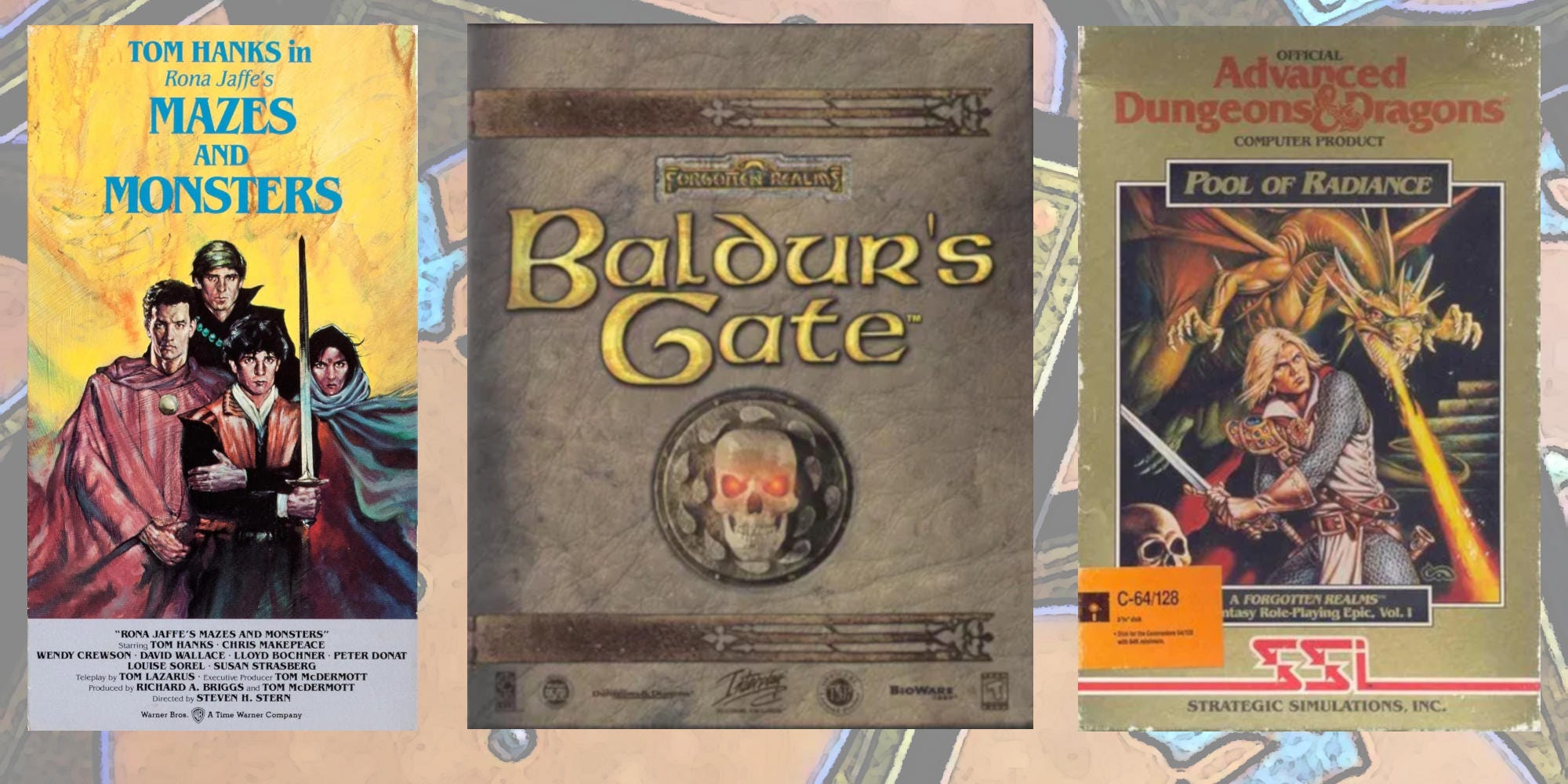
In 1979, a story broke that a university student in Michigan had disappeared in the school’s steam tunnels while playing a live-action version of D&D. A 1982 TV-movie, Mazes and Monsters, starring a young Tom Hanks, was based loosely on the events, and wildly misrepresented the role-playing hobby in a manner reminiscent of the classic Reefer Madness. It was the beginning of a spate of negative publicity, which lead to a backlash against the game from conservative Christian groups who alleged the game promoted demon worship and suicide. This opinion had originating in Patricia Pulling, whose D&D-playing son killed himself in 1982, although there is no evidence the game was a factor in his death. Three years later, Pulling appeared on 60 Minutes opposite Gary Gygax, after which Gygax received death threats and had to hire a bodyguard. He left the company shortly afterwards owing to a dispute with the controlling shareholders, not long after creating the briefly successful Dungeons & Dragons cartoon for CBS, which lead its time slot for two years.
Between the negative publicity and the cartoon show, the media attention on D&D served to raise awareness of the game to new levels, and TSR’s annual D&D sales shot up to $16 million in 1982, and $29 million by 1985. The New York Times speculated in January 1983 that Dungeons & Dragons could be “the great game of the 1980s”. During this time, Basic D&D diverged even further from AD&D under the guidance of new editor Tom Moldvay, who produced the 1981 edition, and the two rulesets were definitively considered to be entirely distinct games. AD&D was supplemented during this decade by many new hardback rulebooks, each of which sold a few hundred thousand units. Basic D&D was supplemented by a sequence of new boxed sets, each dealing with progressively higher level characters – Expert (levels 4-14), Companion (levels 15-25), Master (levels 26-36) and Immortals (level 36+), but the bulk of sales appear to have been for the Basic and Expert boxes. In 1989, the Basic boxed set apparently sold over a million units, annual sales that no other tabletop RPG has ever reached.
The very existence of D&D had been formative for the computer role-playing game genre, and was a clear inspiration for both Ultima and Wizardry: Proving Grounds of the Mad Overlord, both launched in 1981. Both titles were key influences in the development of computer role-playing games, and Wizardry affected designers in both Japan and the US to an enormous degree. Despite this chain of lineage to D&D, TSR were slow to benefit from videogame revenue. Some largely unsuccessful Mattel and Intellivision titles in 1981 and 1982 were eventually followed in 1988 with the first of the popular “Gold Box” titles by SSI, beginning in 1988 with Pool of Radiance, and followed by half a dozen other titles in this line over the next four years, along with a slew of other licensed videogames over the next decade, several of which enjoyed modest success.
The 1990s were not so lucrative for TSR. David “Zeb” Cook’s 1989 revision of AD&D into 2nd Edition removed a great deal of what had offended conservative Christians in the original game, including references to demons and devils, playable evil classes and races, and sexually suggestive art. This version drew less influence from the sword and sorcery fiction of Howard, Leiber and Moorcock, and represented itself as a blend of medieval history and mythology (although the Moorcock-inspired alignment system remained). Unfortunately, the entire tabletop role-playing game market was to suffer a near-fatal blow at the hands of a new contender in the hobby game space with the arrival in 1992 of Wizards of the Coast’s Magic: The Gathering, a unique and addictive trading card game designed by Richard Garfield. M:TG (and to a lesser extent other collectible card games) sucked almost all the air out of the balloon for tabletop RPGs, and drove many companies bankrupt.
The final insult for TSR came in 1997, when the ailing company was purchased by Wizards of the Coast, the very company that had effectively driven it out of business. Ironically, two years later, Wizards of the Coast was itself purchased by toy giant Hasbro, who had little or no interest in tabletop role-playing, but were very interested in the massive revenues generated by both M:TG and the Pokémon Trading Card Game, which WotC had shrewdly licensed. Ironically, the Hasbro acquisition united Dungeons & Dragons with the company that had paved its way, Avalon Hill, the rights for which had been acquired by Hasbro after the collapse of the ailing wargaming company in 1998.
Under the guidance of Wizards of the Coast, Dungeons & Dragons was finally to enjoy more substantial success in the videogame marketplace, beginning with BioWare’s Baldur’s Gate series (1998-2001), the engine for which also drove the 1999 PlaneScape: Torment, a highly regarded but commercially unsuccessful title by Black Isle Studios, who had also acted as publisher for Baldur’s Gate. However, just as D&D had been slow to take advantage of its influence in the cRPG space, it was too slow to move into the new massively multiplayer online RPG space. Early MUDs, the direct predecessors to MMORPGs, had been vastly influenced by D&D (especially the numerous LP and diku MUDs), and there is no reason the Dungeons & Dragons brand couldn’t have moved to dominate the MMO space. Instead, another direct descendent of the ideas that originated in D&D was coming to claim the crown…
Next Week: Hasbro vs Blizzard