


Continuing this month’s revisit of ‘Hardcore’ vs ‘Casual’ gamers, this piece from September 2008 discusses our statistical analysis of game players in the 2000s.
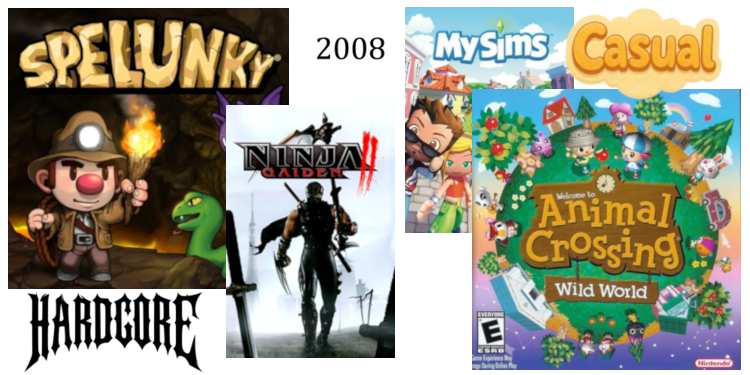
The persistence of the terms ‘Hardcore’ and ‘Casual’ might be credited to the simplicity of the player model implied: people find it easier to grasp an idea that divides people into two boxes than to wrestle with a more complete audience model.
Besides, many people working in videogames are resistant to audience modelling as a driver for the game design process. Often this is because the game designer in question wants to trust their instincts as to what is fun rather than a model. There’s merit to this approach, but surely one’s instincts can be better refined by learning the available models?
Earlier this year, football game legend Dino Dini contended to me that game design could be driven by intuition rather than theory. I agreed with him – it is certainly possible to design this way, and I often do rely upon my intuition – but I also pointed out that whether you used theory or intuition to guide the design process, you don’t really know what you have until you put it into the hands of players who’ve never seen it before. Whatever assumptions you’re making, the players are the ultimate test.
If transitioning to the widespread use of more detailed audience models (Lazzaro’s Four Fun Keys, Bartle Types, ihobo’s Player Motives etc.) is hindered by the relative complexity of such models, perhaps we might at least improve upon what we mean by the paper-thin model we do have in common use – the Hardcore/Casual split.
Game Literacy
In August last year [i.e. 2007], I submitted a post to the games industry Round Table which attempted to look at Hardcore and Casual from the point of view of how much experience of games the player had – that is, in terms of game literacy. There is a lot of merit in what was proposed here, and the key points still stand. The market for videogames consists of a ‘head’ and a ‘tail’. The ‘head’ consists of game literate players (the gamer hobbyists), who buy a greater number of videogames and rack up a greater number of hours playing. The ‘tail’ comprises of less game literate players – the mass market – who are gradually in the process of replacing the gamer hobbyists as the primary source of cash flow in the games space. Nintendo’s ongoing success with their mass market friendly Wii and DS platforms emphasises this shift in the marketplace.
But there are flaws to the substitution of Hardcore for gamer hobbyist, and Casual for mass market. As we are coming to the end of our analysis of survey data from 1,040 gamers (both Hardcore and Casual, based on self-assessment), we are able to examine some of the differences between the two (strictly, three) groupings.
Most of the findings in this regard are trivial. Self-assessed Hardcore gamers rated themselves higher for the importance of all the emotions we inquired about (and all these findings were highly statistically significant) – which is to say, Hardcore gamers were more emotionally invested in their play, or at least more likely to rate the importance of any emotional factor in their play higher. Hardcore gamers also rated themselves higher on every aspect of game literacy or player skills in the survey (and these results were even more statistically significant). Finally, Hardcore gamers were more interested in games of challenge, heavily structured play, and games of escapism (acting out in a fictional world) – all of which broadly validated the findings from our earlier survey.
But these results obscure something interesting about the players who self-identified as Casual. Firstly, Casual players still play games very often. 81% of those who self-identified as Hardcore said they played videogames everyday, but 49% of Casual players also said they played everyday. Hardcore players gave themselves high marks in game literacy (more than 95% of Hardcore respondents claiming the top two marks, and about three quarters the very top mark), but Casual players didn’t exactly rate themselves low on this (around 85% of Casual respondents claimed the top two marks, and roughly half the very top mark). So while some of these Casual players might be mass market players, many of them are highly game literate players who play videogames every day. (Those who declined to choose between Hardcore and Casual looked remarkably similar to those who self-identified as Casual).
What other factors might be in play?
Punishing versus Forgiving
In January of this year [i.e. 2007], the host for the games industry Round Table discussions shared thoughts about what characterised Casual games (as opposed to Casual players). They characterised these games as forgiving:
Casual games are typically very forgiving games. They don’t harshly penalize failure, they have gradual increases in difficulty, they don’t demand you spend large blocks of time in one sitting. They don’t have complicated control schemes or complex mechanics. Typically, you don’t even have to read to be able to play (excepting Bookworm and its ilk, obviously).
This formulation of Casual games as forgiving is a major step forward in understanding Casual players! On the basis of case studies at the very least, Casual players are looking for games that are indeed more forgiving – and along the same lines, more welcoming. They don’t necessarily want a big time commitment (but may still spend a lot of time playing a particular game), and they certainly don’t want to be punished for their failures – they want failure to be forgiven.
This was part of the genius behind the design of PopCap’s evergreen favourite Bejewelled. It not only allowed you to excuse yourself from additional stress (by opting out of a timer – a major source of excitement in play, but also a source of unpleasant panic for certain players), but it doesn’t penalise you for making a mistake. Swap two jewels that don’t make a line and you’ll just be warned that you made a mistake – no score penalty, no penalty of any kind. This was a break from a tradition of punishment that runs throughout the history of videogames, and it found an eager audience waiting for it.
Conversely, the gamer hobbyists include a great many players for whom the ‘old school’ sensibilities of the arcade and the early home videogames are more desired – games in which you are up against impossible odds, where you will fail often, and be punished for the slightest misstep. [Even three years before the release of Dark Souls, the play needs this game would meet were already evident.] Why are games in these styles enjoyed? Because punishing failure makes success all the more vital to strive towards and so the threat of punishment adds not only excitement to the play of the game, but it intensifies the reward in triumph (or fiero, the emotion of triumph over adversity) that is the ultimate pay off when success if finally attained.
This, then, is the other side of the Hardcore/Casual split – not the division of the market based upon game literacy, but the division of the players according to whether they are looking for a forgiving game (one that will welcome them, and behave in a civil and friendly manner) or a punishing game (one that will raise the degree of challenge and dare the player to rise to the level of difficulty that it demands, in order to earn the biggest payoff in the experience of triumph when victory is eventually attained).
It may be tempting to associate ‘forgiving’ with female players, but it would be a gross simplification to assume that this is an adequate and complete explanation. There are female players looking for punishing games, and there are plenty of male players who want a forgiving game – Animal Crossing is a quintessentially forgiving game, and its audience shows no gender bias. The DS version has sold more than 9.5 million units, almost twice the audience that a typical punishing first person shooter can even hope to attract [in 2008].
Conclusion
The Hardcore/Casual split doesn’t work any more. It’s an incomplete description because as games have pushed deeper and wider into the demographic landscape the old assumptions have failed. Hardcore might mean game literate, and it might mean seeking punishing games, but there are players who self-identify as Hardcore and yet detest any game that will make them feel angry (an emotion that enhances triumph, and can be associated with punishing games). We have no way of distinguishing between those two state of affairs in our current language.
Similarly, Casual might mean less game literate, but there are a great many players who self-identify as Casual but who are clearly well versed in the language of gameplay. And Casual might mean desiring more forgiving games, but about one in five players who self-identify as Casual still say they looking for (or willing to tolerate) anger in their play – roughly the same proportion as in Hardcore players. Once again, the term describes multiple different kinds of players, between which we cannot distinguish in our current language.
If we want to better understand the marketplace for games, perhaps we should start thinking in terms of two very different splits. The split between game literate gamer hobbyists, and less experienced mass market players on the one hand, and on the other the division between victory-focussed players seeking punishing play (challenge-oriented, triumph-seeking players) and players seeking forgiving play (who do not want games that make them feel angry). Hardcore and Casual is a compromised terminology – it means too many different things, and it no longer reflects the state of the marketplace. The time has come to move forward into a new language for describing the essential splits in the audience for videogames.
Much of what this piece discussed in 2008 still applies today! Interestingly, we anticipated the rise of ‘cosy games’ in the late 2010s. These are the perfect example of what this piece calls ‘forgiving play’, and a major segment of the commercial landscape for videogames today.