


One of the most influential games of the last century was Dungeons & Dragons. This is not to suggest it has enjoyed enormous commercial success – it hasn't. Except, perhaps, in contrast to other role-playing game systems, which (other than White Wolf's horror-fetish World of Darkness and perhaps Steve Jackson Games' GURPS and Chaosium's Call of Cthulhu) have suffered either instant or lingering commercial failure. Estimates state some 20 million people have played D&D since its inception – impressive figures, especially for tabletop role-playing games, although for comparison bear in mind that Trivial Pursuit sold 20 million units in 1984 alone.
The influence of Dungeons & Dragons, or D&D, can be divided into two specific aspects: firstly, there is the mechanical influence, which has been felt most strongly in the videogames industry. The progress structures that were developed with this game are compelling and addictive, and become even more so when the rate of progress is increased, as it is when similar structures appear in videogames. In tabletop D&D, a player would be lucky to gain a level each week that they played. In a computer RPG, a player would be surprised not to gain levels in the space of a few hours, or even minutes near the beginning of the game. Not only computer RPGs but videogames in general owe a huge mechanical debt to D&D – even Grand Theft Auto: San Andreas contains reward structures descending from D&D amongst its mechanics.
The second influence – which is less commercially relevant but is just as culturally significant – is the confluence of narrative and play in what has been called participatory storytelling. Prior to D&D there were no mechanics for this kind of play – only children created ad hoc stories together; adults might write fiction, but they did not perform fiction with one another outside of improvisational theatre. The genius of Gary Gygax and Dave Areneson was to recognise that the central mechanics in wargames had a potential beyond that of representing conflict – the fundamental elements of these games were applicable to a more narrative form. Chainmail (by Gygax and Jeff Peren), the direct predecessor to D&D, was a 1971 wargame with rules for fantasy monsters and one-on-one “swashbuckling” action, inspired by the works of J.R.R Tolkien (Lord of the Rings) and Robert E. Howard (Conan) among others. It rapidly became apparent that this direction could lead to a new kind of a game – one in which the focus was individual heroes and their stories, not whole armies.
Thus was born the original Dungeons & Dragons boxed set, published by Tactical Studies Rules in 1974, back when the height of videogame sophistication was Pong. The original white box edition was essentially incomprehensible to anyone who was not already familiar with wargaming, but still proved hugely popular in comparison with the wargames available at the time. In this regard, it is important not to underestimate the role of Avalon Hill in the success of D&D: without the venerable wargame company paving the way for hobby gaming in general, it would have been essentially impossible for D&D to gain its initial foothold. Only because a niche market for esoteric and often complex boardgames had been established was it possible for role-playing games to spread so rapidly among university students, high schoolers, and other stalwarts of hobby gaming.
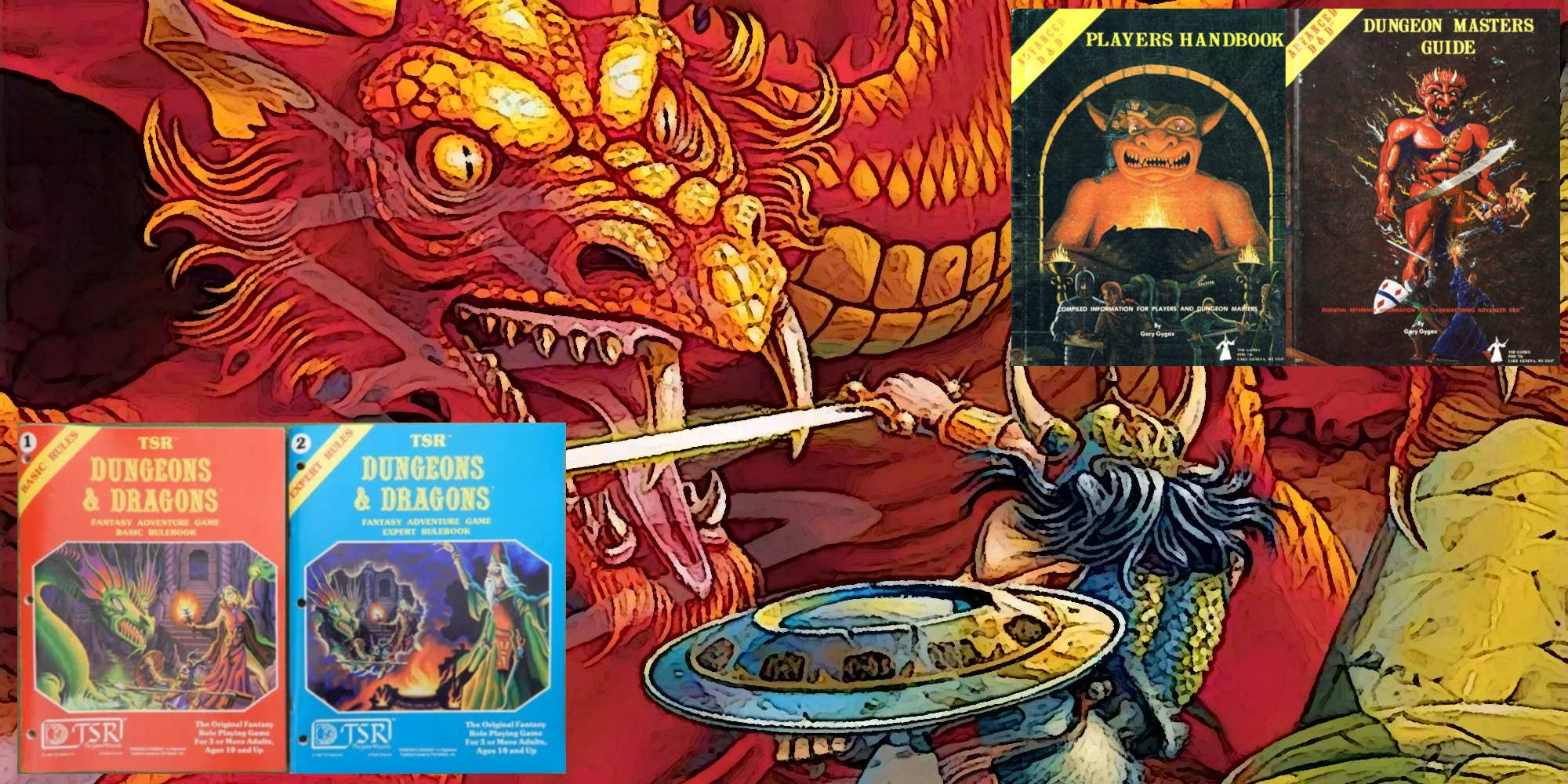
In 1977, TSR Hobbies (the next in the long chain of companies in the TSR lineage) began a two-pronged market strategy in respect of the then hugely popular (in hobby games terms!) D&D franchise. On the one hand, Basic Dungeons & Dragons retained the boxed set format (ideal for sale in toy stores) and was designed to be an introduction to the game for new players. On the other, Advanced Dungeons & Dragons was offered as a series of premium hardback rulebooks, intended for players of the basic game to “graduate” to, as they mastered the rules. The core of the advanced game came in three books published initially over three years: Players Handbook, Dungeon Masters Guide and Monster Manual, a schema which still exists to some extent today. TSR's product line for D&D was also supplemented by some third party companies such as Judges Guild, which published licensed AD&D content up until 1982.
The basis of the two-pronged strategy was sound: having a cheaper introductory version coupled with a more expensive advanced version made it easier for players to get into the game, and gave experienced players additional options. Unfortunately, the integration between the two versions was scant, and each was actuated by a wildly different design philosophy. Gary Gygax, in charge of AD&D, wanted rules for every conceivable situation (far more, in fact, than any player ever used). Eric Holmes, in charge of Basic D&D, preferred a more stripped down approach, with more room for improvisation. In this regard, it was almost as if the split echoed the two influences cited above: AD&D followed the mechanical line, while D&D followed the role-playing line, loosely speaking. There is a certain irony to Gygax leading the more complicated rule set: he had once quipped that TSR would be in trouble if the players ever realised that they didn't actually need any rules...
Next week: Rise of the Wizards of the Coast
New player here. After reading parts of the Dungeon Master’s Guide, I can see why many would be turned off by the “work” one puts into the organic nature of the game.