


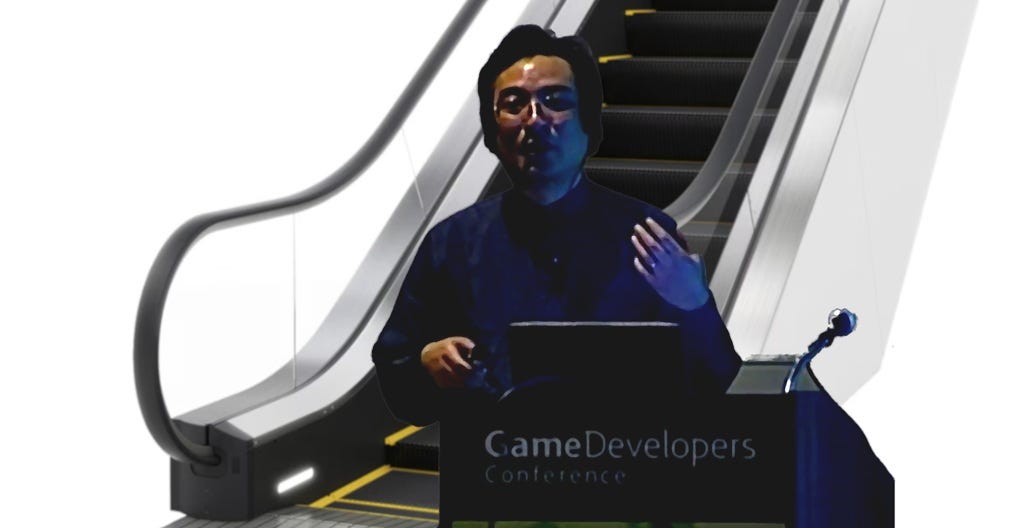
Since I brought this up in my talk at XP Game Summit in May, I thought it might be nice to revisit my original post about the escalator!
A game should possess a clarity of purpose. If it is not clear what the player should be doing, the game has an insurmountable problem. Even games in which you are given a completely open hand only work if this freedom is successfully conveyed to the player. Even games in which the core play is devising what to do only work if the player is sufficiently confident that this is what they are supposed to be doing. Does your game have a clarity of purpose?
When I attended the talk by Pac-man's creator back at GDC 2004, I wasn't expecting the session to develop an almost mystical quality in me. Japanese is an unusual language in that it prefers implication to statement – a quality that often makes it rather hard to translate into the languages of more literal cultures. However, it also meant that Iwatani-san’s presentation was not a carefully structured thesis, but a codex of personal experience centred on the design process behind a hugely popular and successful game. It was the most moving experience I’ve had at any GDC, but it took me some time to completely internalise it.
The image of the escalator was perhaps the most cryptic element of the talk. Iwatani-san asked the audience for their thoughts on what made the escalator a "perfect system"; this audience participation further obfuscated his purpose in choosing this icon. Indeed, at least one report (unless my memory fails me – which it does from time to time) erroneously supplies my suggestion (voiced on the day) as to the strength of the escalator: that even when broken it is still functional, as a broken escalator is a staircase. Only some time afterwards did the gentle zen like effect of the talk finally settle into my mind, and I successfully decoded Iwatani-san’s intended message.
The beauty of the design of the escalator is that anyone can immediately see how to use it. No prior experience, no specialist skills, no instructions are necessary. One can tell from looking at it what is expected. This was the same concept that motivated the design of Pac-man: clarity of purpose. Does your game have clarity of purpose?
Ha ha, the escalator scene in Elf (2003) comes to mind, but it's the exception that proves the rule. It's funny because the purpose is obvious to us.